When the NYPD raided the Occupy Wall Street Encampment at Zuccotti Park this morning, they tossed the 5,554 books that were assembled from donations into The People’s Library, an extemporaneous institution with a proper librarian and its own website, into dumpsters.
According to the story as reported this morning on mediabistro.com: “According to the city’s eviction notice, the “property will be stored at the Department of Sanitation parking garage at 650 West 57th St.” But the librarians dispute this: “it was clear from the livestream and witnesses inside the park that the property was destroyed by police and DSNY workers before it was thrown in dumpsters.”
The People’s Library, set into the North East corner of the Park near the corner of Broadway and Liberty Street, was one of the most beautiful aspects of the occupation site.
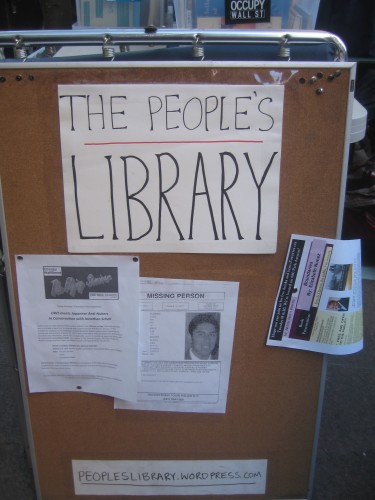
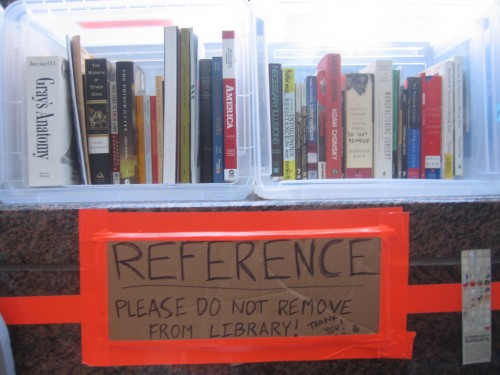
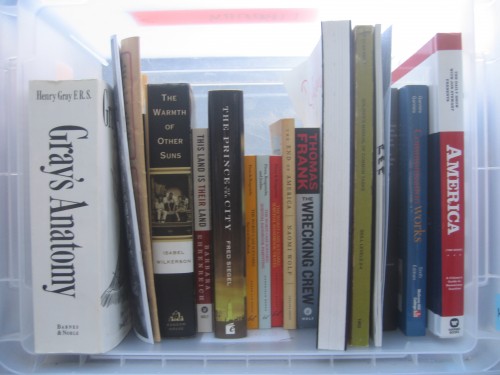
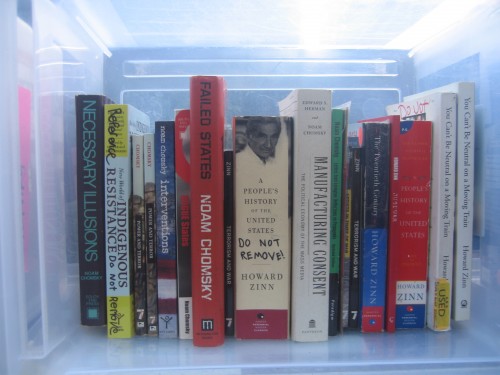
The legality of the eviction is being ejudicated (after the barn door…) as I type, but the city junked everything nonetheless. I hope and I believe that Occupy Wall Street will be back there, and will figure out a new way to outwit the authorities. But if anyone thinks that once set into motion, there couldn’t have been anyway for the police to preserve the books, a story occurs to me.
In 2002 the art historian Leo Steinberg was awarded the College Art Association’s Distinguished Scholar Award He gave, as always and ever, a profoundly interesting but also in this case unexpectedly moving speech. The speech was republished in its entirety in the Brooklyn Rail in 2006, and here are some excerpts that have come to my mind today:
Before proceeding to professional matters, I’d like to recall two bits of family lore from my early years in Moscow, where I was born. I was three, sitting alone, humming a Russian children’s song to myself. In translation:
Little finch, little finch, where have you been?
—Down at the market, drinking vodka.
Hearing this performance, a visiting grown-up asked, did I know what vodka was? Now, the Russian for water is Vadá, and Vodka is its diminutive. So, being asked about vodka, I replied, “Eto málinkaya Vadá”—“it’s small water.” I confess to this story, because it signals an early tendency to address the signifier instead of the signified.
One other tale from this Russian phase I do not believe; at least not in the form my father claimed to have recorded in his diary—which has not survived. At age 3 and a half, looking at father’s bookshelves, I’m supposed to have said:
“Books are like people.”
“How so?”
“Well, the covers are their clothes, and the letters are their teeth, and if you don’t read them, they feel hungry.”
I discount this story because you hate to think that your imagination peaked at age three and the rest all downhill.
Soon after, we escaped Soviet Russia, arriving in Berlin on November 2, 1923, three weeks before my younger sister was born.
…
My parents were Socialists, and one day in December 1932 they took me along to visit a Socialist bookshop, whose owner my father wanted to speak to. While the grown-ups talked, I browsed along the shelves and soon pulled down one of the few books in the shop that had nothing to do with politics: Richard Hamann’s The Early Renaissance of Italian Painting, Jena 1909, in its first printing of 30,000: 50 pages of text, plus notes at the back (none of which interested me); and 200 full-page gray-and-white reproductions of paintings by artists with sonorous names, the like of which I had never heard uttered—Pollaiuolo, Ghirlandaio, Piero di Cosimo.
I was enchanted, and couldn’t stop looking—from that day to this. And when, after too short an hour, I was told we were leaving, I would not reshelve the book, but showed it to mother and asked timidly (for I knew we had little money)—could we buy it? Mother glanced at the price, shook her head, and looked quickly away; and all those images to vanish forever. And then a miracle happened: the bookseller turned to my father and said, “Look, any day now Hitler will be coming to power [as indeed Hitler did five weeks later, January 30, 1933], and the first thing the Nazis will do is close this shop. So why don’t you just take the book for your boy.”
I have the book still, inscribed in pencil in a 12-year-old’s hand, “1932, for Chanukah.”
At this point Steinberg held the book up, “and here is the book.” I don’t know about anyone else, but that’s the only time I’ve ever burst into tears at an art history conference.
But it is the final story he told about the importance of books that is most relevant to today’s depradations by the NYPD:
A year later. We had escaped Hitler early and by late May 1933 were settled in London, where people spoke a language I neither knew nor approved. In English classes at school, if we were told to read and report on a Dickens novel, my practice was subtly subversive. I would bicycle to the public library way out in Hendon, borrow a German translation of Oliver Twist, read it, and then do my report.
One day in 1934, I was on my bicycle with half a dozen library books strapped on behind, coasting downhill. You have to remember that in those days cars in suburban London were scarce, streets had maybe one or two cars parked, and little traffic. So, as I came speeding down, I suddenly saw people waving at me from the sidewalk. I stopped, turned around, and froze in horror. The strap had come loose, my books strewn across the roadway, a bus bearing down to ride over them, and me, condemned to stand by at their massacre, for I had a great sense that books, borrowed ones especially, must be treated with tenderness. They’re like people, remember?
But then—another miracle: the juggernaut slowed and made a careful detour around my books. I choked up—knew from this moment that I had passed into a different culture. Rightly or wrongly, I felt that this could not have happened in Germany, where, on May 10, 1933, my Uncle Aron had taken my older sister and me to watch the Nazi burning of books.
And so I made peace with England, where I would spend the next twelve years, trying to learn the local jargon, so I could eventually be published in The Art Bulletin.
It is possible even in the midst of whatever dynamic event to respect a book, a book is not trash, except in crypto-, proto-, wannabe-fascist/fascist-lite regimes. But you know, Mayor Bloomberg, you may have trashed those books, but I’m happy to say that New Yorkers have enough great books they have no room for in their apartments to create a 100 new People’s Libraries. It will be reconstituted.

screen-shot-2011-11-15-at-2-26-01-am from The People's Library website
Update, 9:47PM: the trashing of the OWS People’s Library and the fate of the books have been discussed and reported on all day, with conflicting threads of information: if you watch Amy Goodman’s excellent coverage from the middle of the night raid itself, it is very hard to believe that any of the books would have survived the raid at all, much less in the way that coverage on the Gothamist later in the day seemed to indicate. This evening Rachel Maddow mentioned the impact of the closing of the Borders in the Lower Manhattan neighborhood and the paucity of nearby New York Public Library branches as reasons that families living in the area were bringing their kids to OWS just to read some children’s books.
The minute that people were let back into the park at about 5:45PM, they began to put some books out and a while later the library website announced that “The People’s Library Re-Opens.”
Update November 16, 1:50PM, The People’s Library issued an update this morning after going to the Department of Sanitation’s facility on the West Side to see what could be retrieved based on Mayor Bloomberg’s claim that everything was intact. Most of the Library books, equipment, and furniture are missing, what remains is often in poor condition. Attempts to begin restoring the library have met with police interference, according to American Libraries, the magazine of The American Library Association:
Tents and tarps are strictly forbidden in Zuccotti Park now. During the reoccupation on the evening of November 15, it started to rain so library staff put a clear plastic trash bag over the collection. Within minutes a detail of about 10 police descended and demanded that the covering be removed because they deemed the garbage bag to be a tarp. There were a few tense minutes as staff tried to convince them otherwise, but ultimately it was removed—leaving the collection open to the elements. As the police withdrew, scores of people chanted “BOOKS … BOOKS … BOOKS … BOOKS.” There was still concern that the park might be cleared again that night, and one officer made it clear that “unclaimed property will be removed and disposed of” in reference to the collection. Library staff quickly set up umbrellas over the bulk of the books and began sending librarians home with bags of books to keep the collection safe in remote locations.
Update November 17, from Occupy Wall Street Library, the game of cat and book continues (video here):
The NYPD seized the People’s Library again tonight. We set up the library again today with 100 books, and the police came over this evening and stood in a line around the books, blocking anyone from reaching the books by creating a fence with their batons. The officers then ordered the Brookfield property sanitation crew to throw them in a trash can. We photographed it all, and video is available on the blog here. The police were asked why they were taking the books and one officer said “I don’t know.”
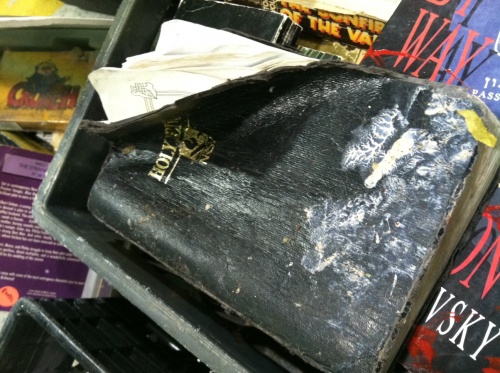
Bible, among books from the People's Library, after the November 15 NYPD eviction/raid, an image I believe should go viral (as an example of "what Democracy looks like" when police in riot gear are deployed against unarmed civilians by elected officials who claim to support the First Amendment while rushing to suppress dissent).


