Yearly Archives: 2011

Money can’t buy you love but art friendships can create joy

The most sustaining force in an artist’s life is supportive friendship with other artists. If at some crucial moments in your life you can form a group of close friendships with artists who share your aesthetic ideals or at least understand and enjoy them maybe even more than you do yourself, you can make it through the incredible difficulties of being an artist: financial peril, near constant rejection, fragility of success. If those friendships also are the basis for artistic collaboration, that is more marvelous still. And there is a particular kind of collaboration among artists who are friends that is special because it takes place outside of the frame of the art market, often before each individual’s path is fixed and their fate is determined, that is before some become rich and famous, while others struggle along, and still others die or vanish from the scene into another type of life than the one of the artist.  Such moments are nearly impossible to sustain, but it can be pretty conclusively proven that these are often the happiest times in the lives of these artists and often too those artworks that later are seen to have the greatest market value emerge from just these moments of friendships and creative projects undertaken in relative conditions of anonymity, for the sheer joy of making and the pleasure in shared ideas.

One such a web of creative friendships among visual artists and writers working in the mid-20th century in New York City, in a close yet liminal social and generational relationship to the New York School, is documented in a wonderful exhibition currently on view at Tibor de Nagy Gallery, Painters and Poets. This exhibition celebrates the 60th anniversary of  the gallery, founded in 1950 by two men with diverse backgrounds–Tibor de Nagy, a well-born but impoverished Hungarian-born refugee banker, and John Bernard Myers who had been the managing editor of the avant-garde art and literary quarterly View.
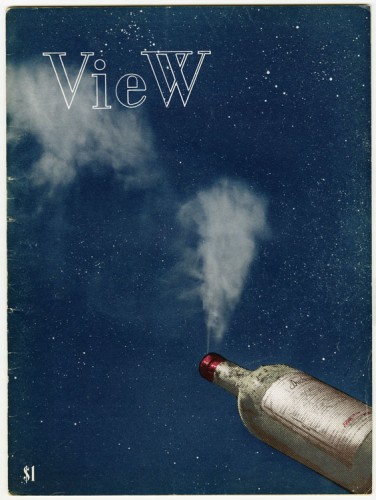
View, March 1945, cover by Marcel Duchamp
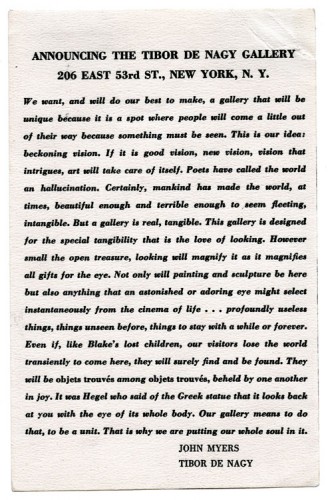
Tibor de Nagy Gallery, Inaugural Statement, 1950

The unique characteristics of the gallery were already marked by its prehistory: de Nagy and Myers had just founded a marionette company which failed when parents kept their children away from public spaces during the polio epidemic of the time. Both men were interested in poetry, the artists who quickly merged into the gallery’s stable were intimately connected with poets, and the gallery began publishing small illustrated chap books and other incunabulae, many of these on view in the current exhibition.
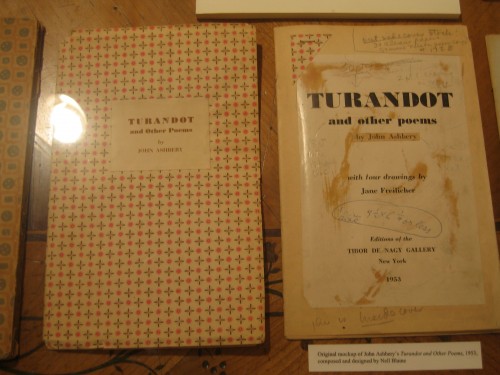
One such work is Joe Brainard and Ron Padgett’s series of small collages collected as the work S, included in the exhibition. In his marvelous book Joe: A Memoir of Joe Brainard, Padgett describes their daily life during the time they produced this work, in a small apartment on East 88th street where Padgett and Brainard, childhood friends from Tulsa who had come to New York around 1960 lived with Padgett’s wife Pat. At the time Padgett was in college at Columbia and Brainard was an unemployed artist.

Joe slept on our living-room couch. Neither he nor I cooked, and Pat was sketchy in the kitchen herself. Breakfast was coffee and, on good days, a Pop-Tart….While I was in class and Pat at work, Joe roamed the city, especially the art galleries, museums, and junk shops, usually alone, sometimes with Ted [Berrigan], and on weekends with Pat and me. There wasn’t enough room in our apartment for him to set up a work space…. It was on Eighty-Eighth Street that Joe and I did a series of small works that we called S. The name came from a flat, metallic gold s that one of us glued onto the lid of a small pasteboard box, the kind that greeting cards come in, and into which we placed the finished works. These were on pieces of cardstock, typing paper, and tracing paper–drawings, words, and collaged material, much of it rather cryptic and hysterical, some of it erotic, some of it with images from Dick Tracy, L’il Abner, and Nancy comic strips. Our working method was highly collaborative; that is, Joe provided some of the words and I provided some of the images. Using the limited media and materials at hand, we worked spontaneously at a table in the living room, passing the pieces back and forth, drinking coffee, and smoking. Joe and I were twenty-one and goofy. Pat was a few years older and far more pragmatic, but she joined in on a few pieces. Over four or five such sessions, we ended up with around seventy works, some good, some puerile, some good and puerile. (Padgett, 61)
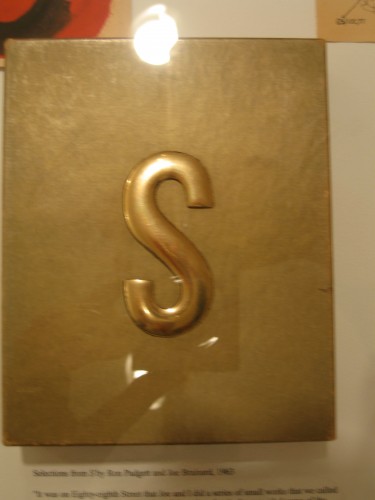
Joe Brainard and Ron Padgett, cover of S, 1963 gallery installation snap shot, Tibor de Nagy
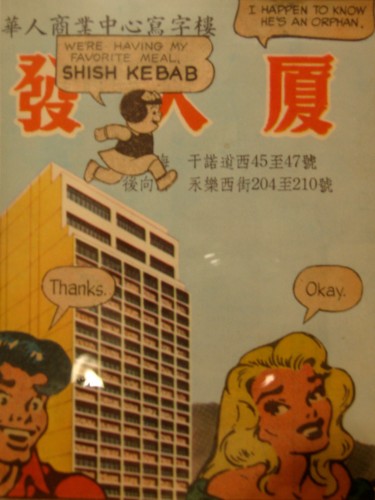
Joe Brainard and Ron Padgett, S, detail, 1963, collage

This may describe an archetypal young artist’s narrative, but it also outlines a situation rather different from the present: Padgett and Brainard moved into a New York artworld where the circles were smaller, more interconnected and accessible, they could survive safely on less money, relative to current economic conditions, and Brainard could become a respected even beloved artist with only the self-education of the city streets and of looking on his own at lots of art, with no institutional framework or timetable except deeply felt personal necessity.

“Painters and Poets” celebrates and tracks a number of crucial friendships from these interconnected circles of artists and poets, some of which were also love affairs, sometimes sexual sometimes not: Frank O’Hara and Larry Rivers, Frank O’Hara and Grace Hartigan, Joe Brainard and Ron Padgett, Joe Brainard and John Ashbery, John Ashbery and James Schuyler, James Schuyler and painter and writer Fairfield Porter, Rudy Burckhardt and Edwin Denby, Rudy Burckhardt and Red Grooms and Mimi Gross, with central figures also including painters such as Jane Freilicher, Rackstraw Downes, Neil Welliver, Yvonne Jacquette, and Alex Katz.

Each of these artists were ambitious and dedicated artists in their own right and could legitimately claim to be at the center of some aspect of the group, and yet the interplay and the productive collaborations were an important part of their creative life. The current exhibition covers this fertile dynamic, with the orbit of Frank O’Hara shifting to the orbit of Joe Brainard, to the orbit of Rudy Burckhardt.These interlinked circles of friendships have been the focus of a number of exhibitions in the past decade or so, all interesting and inspiring: “In Memory of My Feelings: Frank O’Hara and American Art,” initiated at LA MOCA in 1999; “Art and Friendship: Selections from the Roland F. Pease Collection,” (Tibor de Nagy, Summer 1997); “Rudy Burckhardt” (also at Tibor de Nagy, June 2000), “Rudy Burckhardt and Friends: New York Artists of the 1950s and 60s,” (New York University Grey Art Gallery, May 9-July 15, 2000); “Semina Culture: Wallace Berman & His Circle” (Grey Art Gallery, January 16-March 31, 2007), and “New York Cool: Painting and Sculpture from the NYU Art Collection” (Grey Art Gallery, April 22- July 19, 2008); and also in 2008, “Picturing New York: The Art of Yvonne Jacquette and Rudy Burckhardt” at the Museum of the City of New York.
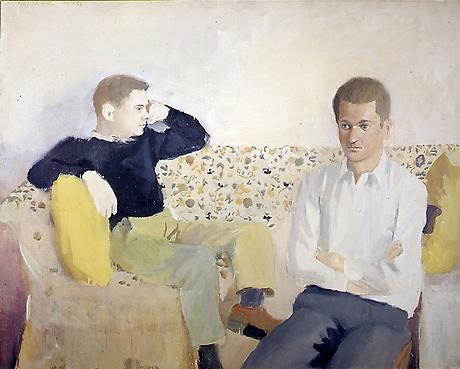
Fairfield Porter, Jimmy and John, oil on canvas, 36 1/4" x 45 1/2", 1957-58
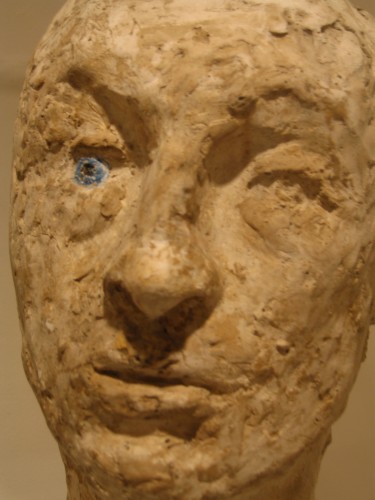
Larry Rivers, Frank O'Hara, c. 1955, detail, plaster, 15 1/2"x7 1/4"

Many of the artists represented in the show and many long represented by the gallery, including Fairfield Porter, Freilicher, Burckhardt and others, worked in a vein of representational painting that was intimate, almost awkward, diffident, yet done with knowledge and experience of the just waning movement of Abstract Expressionism. Their works are among those that led me to suggest a category of “Modest Painting,” where ambition for painting is not dependent on huge size or even oppressive ideological rhetoric. As noted by painter Rackstraw Downes, Tibor de Nagy was one of a group of galleries which offered an alternative to the rapidly consolidated official art world of the late 50s and 60s:

To see this, the official art of the 1960s, you tramped Madison Avenue beginning at Emmerich and ending with Castelli. But there was another route which some people took, it included Frumkin, de Nagy, Zabriskie, Schoelkopf, Peridot, Graham among others. In these galleries one saw an art which looked awkwardly inexplicable; like so much of the liveliest art of any time it eluded critical dialectic. By the official art world it was virtually dismissed. And so I would call it the “unofficial” art of the 1960s. This was the world which interested me. It was the only art of quality that did not seem stage-managed; it had no party platform, no campaign. It did not bully you into believing that it was “right,” a condition impossible to art and which, when claimed by a school or a critic, automatically makes the art seem slightly suspect. …In 1964 John Bernard Myers, in an article called “Junkdump Fair Surveyed,” called this art “private.” [Downes, “What the  Sixties Meant to Me,” (1973) 17]
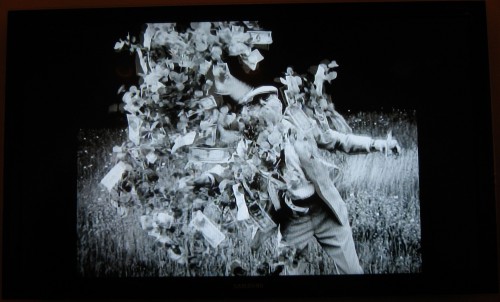
Rudy Burckhardt, Money (1967), screen shot, Edwin Denby and Money Tree

Many of the individual and collaborative works reflect a casual, relaxed approach to creative life underscored by ambition for art and an understated perfectionism. They were serious yet playful and playfulness was not the unique property of youth but a cross-generational process, engaged in by artists who were 19-year old newcomers to New York and people in their 50s and 60s, sophisticated veterans of the New York artworld like Burckhardt and Denby. My favorite piece in the show at Tibor is Burckhardt’s Money, (1967), his first feature film of his 100 or so films, with script by Joe Brainard, about a money mad billionaire played by Edwin Denby, a film which combines a goofy, spontaneous home movie feeling (with actors including Grooms, Gross, Jacquette, Welliver, Downes, as well as these artists’ children, Jacob Burckhardt, Titus Welliver, and Tom Burckhardt–now all adult artists engaged in film, acting, and painting) with thrillingly beautiful scenes with the cinematic quality of Jean Renoir, the neorealism of Roberto Rossellini, sly riffs on the contemporaneous Bonnie and Clyde (1967) and Jean Luc Godard’s Week End (1967) — there are also cinematic parallels to the spirit and the style of scenes going back to the anarchic speed of early Fatty Arbuckle and Buster Keaton or Hal Roach silent shorts and to films from the 1960s such as the one in Agnes Varda‘s Cleo from 5 to 7 (1962) in which a short comic slapstick silent film staring Godard and Anna Karina reenacting how they met (cute) interrupts Varda’s poetic reflection on mortality. There are so many scenes that stay in my mind from Money, not just the ones where I get a kick out of seeing people I knew when we were all young and younger, but just for their cinematic beauty: a boy running down a country road in Maine to recover a single penny he dropped, Denby planting a money tree, and floating up to the sky in a kind of dream of a death where you can perhaps take it with you. [Money has recently been preserved and digitally restored by the Anthology Film Archives in New York and will be screened February 25 and 26]. Of Money, Denby wrote: “The characters are all pretty bad, money is the root of evil, and they ought not to enjoy themselves, but they do anyway.” You will too.
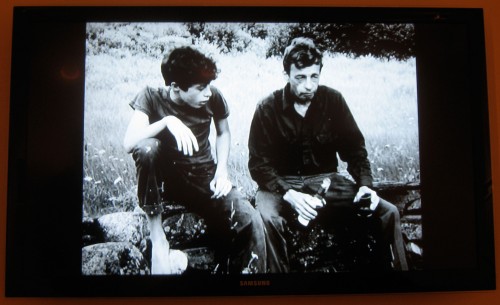
Rudy Burckhardt, Money (1967), Jacob and Rudy, screen shot

[I should add that I am in some small way a member of the artworld family I’ve just described: my parents Ilya and Resia Schor were friends with Chaim Gross. I met Chaim’s daughter Mimi in my childhood and became friendly with her and her then husband Red Grooms when I was about 12.  As soon as I began to navigate the city on my own on the subway I made my way to their studio on Grand and Mulberry Street. One amazing evening in 1968 I met for the first time Rudy Burckhardt, Yvonne Jacquette, their small son Tom, Jacob Burckhardt, Rudy’s son from his previous marriage to painter Edith Schloss, and Edwin Denby — the first sight of these 5 very delicate, kind, and interesting looking people is one of those crisp snapshots that immediately are engraved in your mind as deeply significant–also that night I met the Kuchar brothers, George and Mike, and we watched their movies. A few months later I worked for Red and Rudy on a stop-motion animated film Tappy Toes (1969): incredible to me that I was paid generously (can’t remember what but it seemed very generous to me) basically to hang out with them and get to see how they worked, what they looked at, while doing a menial task of moving small paper cutout figures a fraction of a millimeter at a time frame by frame for Rudy to photograph. And many years later I still live within the ripples of this particular art world, it is not historicist, for many of its participants are still alive, and its influence continues in the work of new generations–my collaboration with Susan Bee on our journal M/E/A/N/I/N/G also connects me to her collaborations with poet Charles Bernstein, who in turn has collaborated with Mimi Gross, and so on. The connections are many and they are important because the values of this world, in important part because of the connection to poetry (less money in this branch of the creative world), are always a vital corrective to the international Art Industry of museums, art fairs, which is as it appears, a capital-oriented and generally impregnable fortress. Within it creative friendships still exist of course, though time, play, and friendship are monitored and monetized in such a way that it can constantly erase the parallel universe of the artworld that Painters and Poets celebrates. ]

FacebooktwittermailFacebooktwittermail

Good night and

The firing–whatever you want to call it — of Keith Olbermann–matters. Many people find/found him abrasive, he was/is often self-important and pompous, sure, he has a big personality, he’s loud, though with a kind of self-aware panache, a flip side that suggested that something like real (as opposed to luridly fake, cf. Glenn Beck) humility lurked under the braggadoccio. In a corporate media atmosphere that masks unity behind the fake appearance of multiplicity of choices (all those hundreds of cable channels owned by about four corporations) and a political atmosphere where recent opinion is that Richard Nixon or Ronald Reagan might not be electable now because they would seem too liberal, every voice that stands for what I consider closer to sanity and fact matters. Even whatever voice passes for “liberal” or “left” opposition within a corporate media structure matters, especially in a time where it does not seem that, in most places or at least certainly not in the United States, any movement is placing its energy into an expansively active criticality of power–as people are trapped by a pervasive acceptance of the idea that the “sixties failed” while struggling to survive in the decaying economies at least of the West in an overstretched damaged global ecology, and a global society so much closer to the regime of complicity and passivity described in The Society of the Spectacle than when Guy Debord first envisioned it.

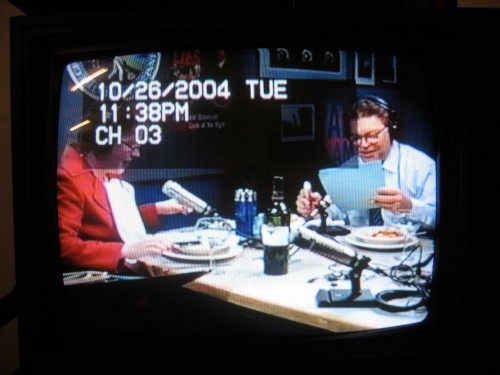
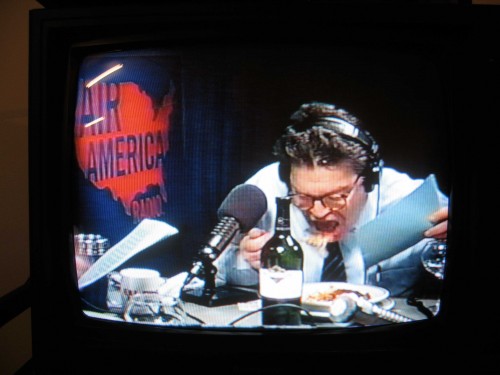
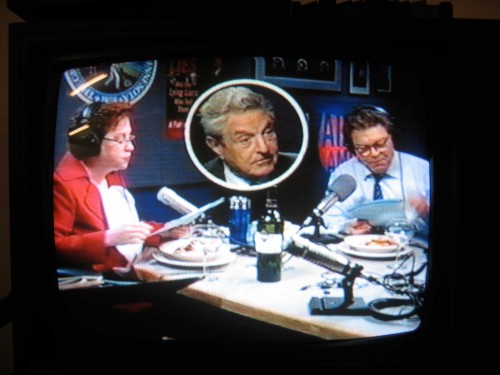
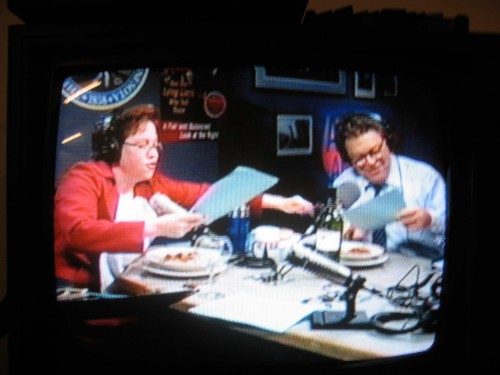
Starting during the Bush administration, appalled by the politics and overwhelmed by political loneliness, I got through, I get through, each day by listening to and watching a series of what passes for alternative political voices in America today.  A typical day, compressing the years’ changing programming into a continuum, would go like this: start the day listening to our mealy mouthed version of the BBC, that is to say NPR’s Morning Edition, I changed NPR outlets mid-stream to avoid the god-awful show The Takeaway, its tempo and superficiality raises my blood pressure–I rely on NPR but I know that, especially ever since September 11, it’s constantly pulling its punches, scared to seem unpatriotic, then an hour of the BBC World Service– gives you a sense of what it’s like to listen to short-wave radio while in an occupied country–then for a brief period in time I’d switch to the wonderful early months of Air America, starting with Rachel Maddow, Lizz Winstead, and Chuck D‘s show “Unfiltered”, followed by Al Franken with Katherine Lanpher–later in the day I would rewatch the Franken show on Sundance Channel, thanks to the generosity and political conscience of Robert Redford–it was so much fun to see the skits after having heard them, there was one which involved a plot by Dick Cheney and Karen Hughes to kill off Bill Clinton by encouraging him to eat himself to death, a GOP version of  La Grande Bouffe, on TV there were Al and Katherine cracking each other up while literally stuffing their faces with goulash and bread at top speed while getting their lines out, with the waiter played by George Soros (can’t find a link, sorry, Senator Al Franken wonderful though he has been so far in the Senate given his lack of seniority, has probably been busy getting rid of as much of his comedian past as possible though some shows are available on Amazon and itunes), oh the sheer joy of those shows!

Meanwhile I’d check into dailykos, read The New York Times, I saved the November 22, 2004 issue of The Nation published after the Gore election in case such publications would soon be eliminated ( I still have it because you never know), then in the evening check into Keith Olbermann (see his Special Comment from 2006 and “Mr. President, YOU Are a Terrorist” from February 14, 2008) followed in later years by Rachel Maddow, then Jon Stewart and later The Colbert Report, and once a week I’d bask in the intelligence, information, and reason combined with a gently expressed sense of outrage offered by Bill Moyers and his panelists, alas a necessary person, I guess it was too much to ask that he work forever, ending the day Democracy Now! with Amy Goodman, again watching a radio show on TV on the CUNY channel. I admire Amy Goodman tremendously, and I love to watch her face because I imagine she looks like a Jane Eyre for our time, with a kind of plain beauty of face voicing unpleasant truths no matter what. Her program is sometimes like bitter medicine, sometimes the sheer awfulness and painful intractability of some of the political situations she reports on is just too much, but nevertheless, so important.

[In case anyone is wondering by now, I’m a news junky and I do watch a lot of TV, but I did manage to paint, teach, edit one book and write another while all this was going on!] But I’m not sure people remember anymore what the Bush years were like: every day brought another assault on something crucial, from the birds and the trees they nest in, to the air we breathe, to our rights as citizens, to war crimes committed in our name, the abominations and threats came so fast and furious that it paralyzed organized citizen response while  the opposition cowered at the fear of being seen as disloyal (Hillary Clinton might be President today if she had stood up against the war early, but she was afraid to). So in that atmosphere these islands of satire, these bits of fact instead of fiction, even these big macho egos deciding to make their names by attacking power instead of sucking up to it, they made a difference. Given recent developments in the US, it might seem that these interventions ultimately failed, but oh God would it have been better without them? If you have Glenn Beck practically putting out a fatwah against a 78 year old professor of sociology through an insane process of guilt by association (see January 14, 2011 Frances Fox Piven interviewed on Democracy Now!), then you need Keith Olbermann and Jon Stewart doing their best to attack and mock him, even if their efforts don’t knock the guy off the air (but I do think Beck ought to watch Network, the end might give him pause).

These voices–the humor, the facts, the satire,the outrage–these individuals acted as safe houses on the difficult journey through each day lived in a corporate, militarist, and incredibly stupid semi-fascist state (hey I’m not a TV pundit or a politician & I haven’t signed any pledge to affect civility in order to mask lack of true discourse or incredible mendacity and cruelty of certain political positions, there is fascism with a mustache, and there’s fascism with a smiley face, not exactly the same of course, but plenty that is reprehensible). The worst thing was the sense of isolation in a sea of conformity in the United States of FOX News. During the Bush years even my dear students would look at me with puzzled concern as I expressed my fears that our democracy was endangered–maybe they were right to just try to live their own lives and not look out further than each individual life’s problems and joys while I worried, but oh what a world that is building.

I think those media voices in concert helped bring about the temporary defeat of the Bush party. I wish they had joined together more often but each one did something, took some chink out of the wall, opened a tiny peep hole into another viewpoint, pointed out one item of clothing the emperor might be lacking. Alas only the temporary defeat, so that the voices continue to be necessary and new ones are needed. So out goes Keith Olbermann, with a curious choice of story by James Thurber to read at the end, “The Scotty Who Knew Too Much.”

I gather he was considered a thorn in the corporate ass despite the money and attention he brought to the corporation in question. Well, if he was, is that a bad thing? I worry about the people that aren’t. What do you have to make nice or keep silent about to keep being liked? They say nice guys finish last, but in America certainly and maybe most of the world, what is scarier is that happy talking or bland-seeming people often finish first.

FacebooktwittermailFacebooktwittermail

While working on a syllabus on a winter’s afternoon

Turn on the radio, or rather listen online to “A Beautiful Symphony of Brotherhood: A Musical Journey in the Life of Martin Luther King, Jr.,” broadcast today on WNYC in honor of Martin Luther King Jr.’s birthday. I listened twice, once as I did the work I describe below, and again as I wrote this brief text.

This afternoon I took advantage of the quiet of this day, a National holiday in the cold of mid-winter, to scan reading material for my spring semester seminar. I’m beginning with a reading of Guy Debord’s The Society of the Spectacle, because it remains a fascinatingly structured, astonishingly prescient, predictive book, giving a portrait of a society that in my memory was not as true when he wrote it as it is now. But from my experience the book can leave students with a sense of hopelessness, since it provides no solutions, there is no exit, resistance is futile. So this semester I want to explore an idea I have had for some time: the applicability of the concept of non-violence to art. I’m certainly not looking to propose pretty peaceful meditative pictures. Rather I want to bring attention to the model of patricidal Oedipal rebellion as central to many avant-garde gestures. I want to look to principles of non-violence as a political strategy to think of ways of existing in without slavishly adhering to the values of a market-driven, spectacular, declarative art economy. So today I was scanning some of the last chapters of Michel de Certeau’s The Practice of Everyday Life.

In one chapter, de Certeau reiterates some of Debord’s vision of a society written by occulted forces that negate individual agency.

This institution of the real no longer has its own proper place, neither seat not ex cathedra authority. An anonymous code, information innervates and saturates the body politic. From morning to night, narrations constantly haunt streets and buildings. They articulate our existences by teaching us what they must be. They “cover the event,” that is to say, they make our legends (legenda, what is to be read and said) out of it….These narrations have the twofold and strange power of transforming seeing into believing and of fabricating realities out of appearances. A double reversal. On the one hand, the modern age, which first arose out of a methodic effort of observation and accuracy that struggled against credulity and based itself on a contract between the seen and the real, now transforms this relation and offers to sight precisely what must be believed. Fiction defines the field, the status, and the objects of vision. The media, advertising, and political representation all function in this way. (de Certeau, 186-7).

But de Certeau’s theme is that there exists a knowledge that precedes theory and which  retains voice even when speech attempts to subsume it. It is the same knowledge that causes the city dweller to inscribe living patterns of usage onto the grid of the planned city.

In turn, the “voice” will also insinuate itself into the text as a mark or a trace, an effect of a metonymy of the body … a transitory fugitive, an indiscreet ghost, a “pagan” or “wild” reminiscence in the scriptural economy, a disturbing sound from a a different tradition, and a pre-text for interminable interpretive productions.

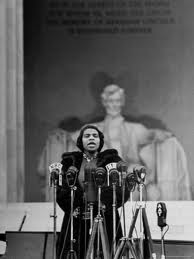
On the radio, “A Beautiful Symphony of Brotherhood: A Musical Journey in the Life of Martin Luther King, Jr.,” is an incredibly informative and moving education in history through music, and in the  power that art can have in a political movement. There are so many miraculous passages in this program: the sweet contralto and slow tempo of Marian Anderson singing “My Country ’tis of Thee” on Eastern Sunday April 9th, 1939 to an integrated crowd of 75,000 people gathered at the Lincoln Memorial, the deep uncanny voice of Odetta singing in the same spot twenty-four years later at the March on Washington for Jobs and Freedom, August 28, 1963 to a crowd of 300,000. “Oh Freedom, Oh Freedom, Oh Freedom over me, and before I’ll be a slave, I’d be buried in my grave, And go home to my Lord and be free.”

As I scan some pages from Mark Kurlansky’s  Non-Violence: The History of A Dangerous Idea, so dangerous there is no proactive word for it, only a word defined by the primacy of its opposite, violence, I listen to the music that Dr. King listened to on the car radio as he drove alone to Montgomery, Alabama for his first job interview: Donizetti’s “Lucia di Lammermoor: Regnava del silencio,” which, he later wrote, transformed the monotous drive into a radiant experience. On one of the pages I scan for my students, Gandhi is quoted as writing: “Given a just cause, capacity for endless suffering, and avoidance of violence,  victory is certain.” “Capacity for endless suffering” is key in my thoughts here, not to focus on the meditative as it sometimes appears in contemporary culture, as a panacea, but on the power of grief when it is expressed as does Mahalia Jackson, heard in this program singing at King’s funeral, “Precious Lord, take my hand,” his favorite song, which he had once requested be sung at his funeral. Every word, every syllable, every sound has meaning, deep meaning. Here is voice, both literal and metaphorical. It was listening to such voices and such “voice” when I grew up that made me believe in the power of art, in the power of language (for the good not only the bad or the stupid), in criticism too and even outrage, but never cynicism.

FacebooktwittermailFacebooktwittermail